
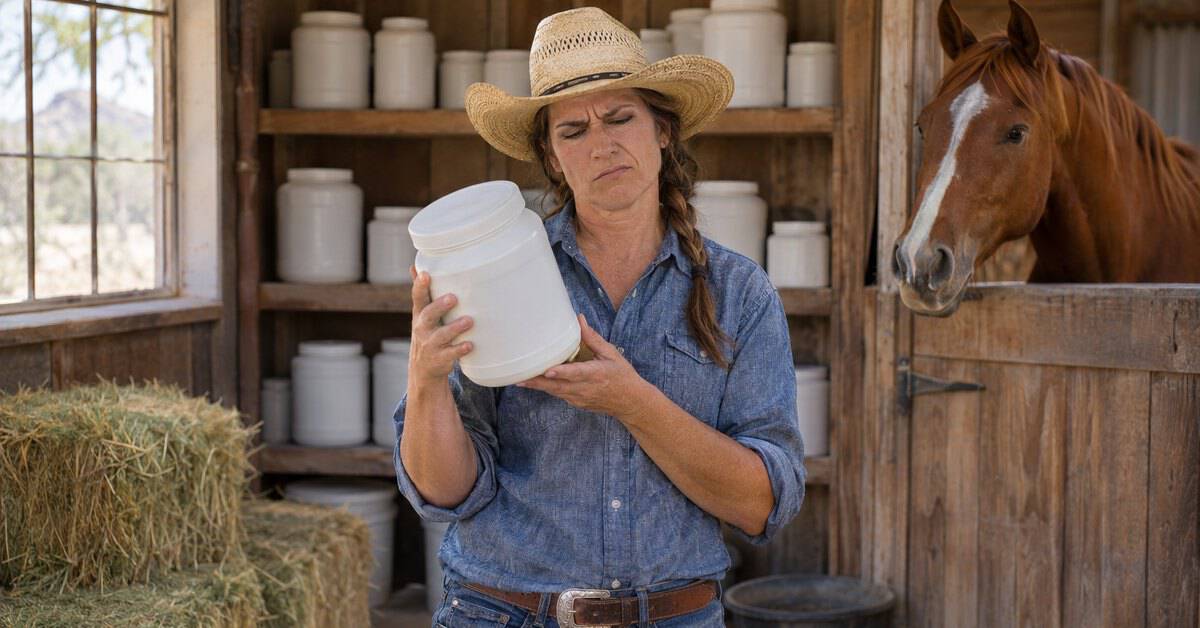
That tub talks big.
Let’s check its papers.
You know how you’re in the feed store aisle, or shopping online? Staring at one more tub for your horse?
And your horse still isn’t himself.
Billions of live cultures.
Every horse group and Reddit post you’ve ever seen swears by it.
Then you think back to the half-used tubs on your feed room shelf. Everyone talked a big game too, but do they actually stack up?
You’ve tried everything and thrown your hard-earned money at scoop after scoop, but you saw no difference.
That’s why I went through the key horse probiotics studies so you don’t have to.
So you can walk into the feed room with your head on straight and stop second-guessing his feed bucket.
I’m Sierra Green, an equine biologist, and I study horses. Here’s what made me turn those tubs around.
Picture it: that tub open since spring. One scoop each morning. Same horse. Same shrug. The lid doesn’t even seal anymore.
The short version
- Just four of 15 products met their count claims in one study.
- Live in the tub is just the first hurdle.
- Foals in two trials were more likely to need a vet.
- Hay and grass feed the good gut bugs he already has.
- Prebiotic fiber has mixed research, too.
Billions of what, when?
I’d like to know what actually shows up in the bucket, wouldn’t you?
In 2011, Weese and Martin cracked open 25 animal probiotics and checked what was actually inside. Of 15 products with a count claim, just four met it.
How many microbes are actually alive? Live counts ranged from zero upward.
Zero. That’s quite a gap, don’t you think?
That same study found 7 of the 22 tubs that named their microbes got those names wrong on the label. If they can’t spell what’s inside, how sure can you be about the rest?
Weese’s 2003 review found wrong microbe names on 8 of 23 products sold for animals. That was a label check, not a count of live bugs.
A count on a label is like sale-barn papers. Wouldn’t you still like to meet the horse?
Here’s the catch: what’s actually left when you open the tub?
Heat, dampness, and time can cut how many of these so-called good microbes survive. These studies don’t tell us what’s in every tub today, so I don’t trust the big number.
But finding a tub that has the microbes you want, and that aren’t dead on arrival, is just the beginning.
Horse probiotics still have to make the trip
Before we send those bugs anywhere, let’s sort out four names.
Penn State puts it this way: probiotics are live bugs, like bacteria or yeast. Prebiotics are bug food, like fiber, and a synbiotic pairs the two.
Postbiotics are the non-living bits those bugs leave behind.
Now your question: do these bugs actually reach his gut and stay where they’re supposed to?
Like a green colt at his first rodeo, getting there and staying put are two different jobs.
Just 18 made the cut. In 2004, Weese and colleagues tested 47 bug strains taken from horses. A strain is a type of bug. In lab tests, those 18 handled stomach acid and bile, like what they’d meet in his gut.
Just because these microbes are equine-specific strains doesn’t mean we can give them a free pass.
Weese’s team fed adult horses one strain at high doses in 2003. Gut levels were low and bounced around, and the bugs only stayed put at a very high dose.
The top dose was 50 billion live microbes for every 110 pounds of body weight, each day. For a 1,100-pound horse, that’s about 500 billion a day.
Even the strongest product in the 2011 study would take about half a pound a day to get there. And gut levels were still low even then.
Steady didn’t mean high. The bugs showed up more often, but there still weren’t many.
So a tub would run out far sooner than the label says.
So unless you’ve got a gold-plated horse trailer, that’s probably not realistic for the average horse owner.
And you may not want that anyway, given what came next.
The foal trials made me pause
Before we go on, who was in these trials?
153 newborn foals took part in Weese and Rousseau’s 2005 trial. Foals given probiotics were more likely to look dull, go off feed, and need a vet. Is that our goal here?
Then came 72 foals in Schoster and colleagues’ 2015 trial, but there was no drop in loose manure.
Foals given probiotics were more likely to need vet care. Fine if that’s your goal, but it’s definitely not ours.
Those findings were in foals. We’ll come back to that.
That spring tub isn’t looking any better.
One more finding stopped me cold
Research has found that after antibiotics, probiotics actually slowed the gut’s return to normal. That’s a problem. Suez and colleagues, 2018.
I don’t get to keep only the results I like.
So what’s feeding his gut before any scoop goes in?
Before the scoop, check the hay
Back in your feed room, let’s look at your horse. What’s he actually eating every day?
Penn State says those gut bugs are a major contributor to his energy. They work in the hindgut, the back part of his gut.
Hay and grass are their main food. That’s the most important foundation to check first, before any tub.
The hay isn’t supposed to sit behind all the shiny tubs, because it’s the base everything builds on.
University of Florida puts his daily hay or grass at 1.5 to 2 percent of his body weight. One percent is the floor, and feed changes should take one to two weeks.
Using hay pellets? Standlee’s feeding guide calls for a hay-to-pellet swap over seven to 14 days.
Your vet or an equine nutritionist can help you sort that out.
Once you’ve checked the hay, what about the fiber in that scoop?
Feed the bugs he already has
Prebiotic fiber is food for the good gut bugs he already has.
I like that idea, but it still has to hold up to the research.
More kinds of gut bugs showed up in a small 2019 study by Glatter and colleagues. They fed 12 horses a meal rich in prebiotic fiber, but other shifts were mixed.
But 12 horses is a very small sample size. That certainly doesn’t settle the whole question.
Hay and grass, fiber, and how you feed. Coverdale’s 2016 review kept coming back to those three things. It also found better fiber breakdown with prebiotic fibers during a sudden feed change.
Even when it’s in my scoop, fiber still has to earn its place. The support is modest at best, and the results are mixed. Hay and grass are still the foundation.
And that’s why Victory was born
Here’s what I make, and yes, I hear it: isn’t that another tub?
Victory is whole food nutrition that actually feeds the microbiome naturally, the way nature intended. It’s not lab-grown microbes that may or may not be in your tub, as previously mentioned.
Victory Protocol pairs Victory with Ulcer Defense Emergency Formula. You mix both in his feed each day, usually as a top-dress at the morning feed.
Victory is my proprietary blend of whole seeds and coconut flesh, ground, fresh to order, in small batches, right here in Northern Arizona. I mix them in exact ratios to support his gut health.
His scoop has all 20 amino acids in whole food form, the most bioavailable form of nutrients you’ll ever find for your horse. So that he has building blocks for muscle and topline, instead of another scoop of guesswork.
There’s also omega 3, 6 and 9, plus MCTs, which are medium chain fats, for quick energy from healthy fats. And natural vitamins and minerals, plus prebiotic fiber.
Recent studies have shown coconut oil may kill funguses that cause leaky gut, such as candida. Not only is it an excellent source of quick energy, it’s antimicrobial and antifungal as well. A true superfood for your horse.
Low in sugar and starch, too, and no fillers, binders or sugars.
He needs all 20 working together, and a missing one is a problem.
If his feed comes up short, his body pulls them from his own muscle, and that’s not the goal.
Low sugar and starch, so his bucket supports a steady gut, instead of piling on more.
Then there’s Ulcer Defense. It’s a blend of all natural herbs, roots, and added polyphenols, which are plant compounds. It has just the right plant extracts to support his gut health and a healthy inflammation response.
Ulcer Defense has research-backed ingredients that help destroy harmful bacteria. [3] [6]
Ulcer Defense Emergency Formula has herbs, like Ginger root, Glycyrrhiza glabra root and Cayenne Pepper. Research shows extracts or compounds from these herbs can slow the growth of harmful stomach bacteria. [1] [2] [3]
Here’s how. In Ginger root, the working part is a group of plant compounds called gingerols. [1] In Glycyrrhiza glabra root, plant compounds called flavonoids slowed the bacteria. [2] In Cayenne Pepper, it’s capsaicin, the heat in the pepper. It stopped the harmful bacteria but left a harmless gut bacteria alone. [3] It’s also proven to increase blood flow to injuries, which is particularly useful in an injured gut.
The Emergency Formula is the extra-strength formula, and we recommend using it 2 or 3 times a year, depending on demands and environment. It’s a much more potent formula to help reset and cleanse the gut from head to tail.
You wouldn’t give a horse antibiotics every day, so you don’t feed the strongest formula daily forever.
After the reset, Maintenance takes over with a gentler mix for ongoing support. It helps keep his gut a good home for healthy microbes.
When you’re ready for everyday support, take the 60-second quiz on our homepage to find what you’re looking for.
Or, if you already ordered from your quiz results, you’ll switch to the Maintenance Protocol in month 3 automatically. That’s hassle-free gut support on autopilot.
Ulcer Defense Maintenance Formula has Hibiscus flower. Research on Hibiscus flower extract found fewer harmful gut bacteria, like E. coli and Salmonella. [4] [5] How? A study found hibiscus acid, a compound in Hibiscus flower, damages the outer layer of these bacteria. [6]
Mixed by an equine biologist who understands cellular biology, not just nutrition. That cell knowledge is an often overlooked part of equine nutrition.
We handcraft everything in small batches, right here in Arizona, so it reaches your door fresh. It hasn’t spent months or years on a store shelf, losing strength.
Prebiotic fiber, the kind his gut bugs can actually use, so you feed the good microbes he already has.
You aren’t just hoping new ones survive the trip.
So what should you check before another tub comes home?
Before the next tub comes home
With horse probiotics, I check the count, the trip and the results. With fiber, I keep the mixed research in mind. And I start with his hay.
You need a place to start, and your shelves may be cluttered with half-used tubs. If you’re like a lot of horse owners, those tubs never really seemed to make much of a difference.
Take 60 seconds to find his starting point: his hay, a scoop, or both. Before your next feed-store run, while you can still see what’s sitting on that shelf.
What will your answers show?
Frequently asked questions
Do horses need probiotics?
Research hasn’t shown that every horse needs a probiotic. For most horses, good hay and steady meals do the most for his gut.
Do probiotics actually work?
So far, the proof in adult horses is thin. In lab tests, just 18 of 47 horse strains stood up to stomach acid and bile.
What do probiotics do for horses?
The idea is to add good bugs to his gut. Probiotics are live bugs, and prebiotics are their food. A synbiotic has both. Postbiotics are the non-living bits those bugs leave behind.
Should I give probiotics with antibiotics?
Ask your vet first. The research certainly has not been settled for horses, but it’s not looking good.
Can you give a horse too many probiotics?
No study has set a best dose for horses. Even at very high doses, gut levels stayed low.
How can I tell if a probiotic tub is any good?
Like we covered above, you’re not always getting what you think you’re getting. Names can be wrong, and there can be far fewer live bugs than the label says. In one study, seven of 22 labels got the bugs’ names wrong. Add heat, damp and time, and what’s left may be far from what the label promised. So a lot of tubs may end up largely a waste of money. One tip: check the date on the tub, and keep it cool and dry.
Probiotics or prebiotics: which is better for my horse?
Prebiotic fiber feeds the good bugs he already has. But the research is small and mixed. Hay and grass are still the base.
What’s in Victory Protocol?
It’s Victory plus Ulcer Defense Emergency Formula. You mix both in his feed each day. Usually, both go in his morning feed. Victory is whole food from whole seeds and coconut flesh. It has all 20 amino acids and omega 3, 6 and 9. Its fiber feeds his good gut bugs. Ulcer Defense Emergency is the strong one. It helps reset his gut. Slippery elm bark helps coat his stomach. Our herbs help cut down bad bacteria. It also has polyphenols to support a healthy inflammation response, all for good gut health.
Talk to your vet about your horse’s health.
Before your next feed-store run: Take the 60-second quiz.
Sierra Green, equine biologist and co-founder of Elite Equine Health & Performance
Sources
- Weese & Martin 2011, Can Vet J (PMID 21461205)
- Weese 2003, Can Vet J (PMID 14703084)
- Weese et al. 2004, Equine Vet J (PMID 15163044)
- Weese et al. 2003, Can Vet J (PMID 12715981)
- Weese & Rousseau 2005, JAVMA (PMID 15989186)
- Schoster et al. 2015, J Vet Intern Med (PMID 25903509)
- Suez et al. 2018, Cell (PMID 30193113)
- Glatter et al. 2019, PLoS One (PMID 31393892)
- Coverdale 2016, J Anim Sci (PMID 27285904)
- Penn State Extension: Pre-, Pro-, and Postbiotics
- UF IFAS Extension: Stretching Your Hay Supply
- Standlee: Feeding Instructions
- EEHP: Victory Protocol
- Mahady et al. 2003, Anticancer Res (PMID 14666666)
- Fukai et al. 2002, Life Sci (PMID 12127165)
- Jones et al. 1997, FEMS Microbiol Lett (PMID 9011042)
- Portillo-Torres et al. 2021, J Med Food (PMID 34255570)
- Gomez-Aldapa et al. 2018, J Food Prot (PMID 29320233)
- Portillo-Torres et al. 2025, J Med Food (PMID 41386811)
The statements made regarding these products have not been evaluated by the Food and Drug Administration. The efficacy of these products has not been confirmed by FDA-approved research. These products are not intended to diagnose, treat, cure or prevent any disease.


